This post contains affiliate links. If you make a purchase through these links, I may earn a commission at no additional cost to you. Prices are current as of July 2026 and change often. Nobody paid for a mention here, and the products below are the ones that fit the criteria in this article, not the ones with the best commission.
Terminal B bathroom, somewhere around 11 p.m., and the mirror over the sink was doing me no favors. My cheeks had that stretched, papery pull you get about four hours into a flight, the kind where you smile and can feel your own face resisting. Foundation had gone patchy along my nose. My contacts were welded on. And my son was outside the door asking, for the fourth time, whether we could get pretzels.
So when a press release landed in my inbox this week claiming that where you sit on the plane decides how bad that gets, I paid attention. Fresha, a beauty and wellness booking platform, put out a seat-by-seat map of which spots wreck your skin. Window seats: worst. Aisle seats mid-cabin: best. Seats over the wing: the safest of all, apparently, because of how humidity behaves there.
Half of that release is genuinely good, well-sourced information that matches everything researchers have measured about cabin air. The other half is a seat chart with no study, no instrument readings, and no methodology behind it. I spent a morning with the actual papers so you don’t have to, and the split is clean enough that I can tell you exactly which parts to trust.
Key Takeaways
- Cabin air dries your skin. That part is measured and undisputed. Relative humidity falls below 10% within two hours of takeoff and holds there for the rest of the flight.
- Facial skin loses moisture fast. One study tracked up to a 37% drop in cheek skin capacitance during a long-haul flight.
- The seat map has no evidence behind it. Cabin air is fully exchanged every two to four minutes at 20 to 30 air changes per hour, which leaves no room for a humidity gap between 14A and 14C.
- Fresha is a booking marketplace, not a research body, and published no methodology for its seat analysis.
- Real experts genuinely disagree about window-seat UV. Cancer Council Australia says passengers face no credible sunburn risk. Many US dermatologists still recommend SPF by the window.
- The prep advice in the release is sound. Skip retinol and acids for 24 hours, apply a barrier cream before boarding, drink water before the cart comes.
- Closing the shade settles the whole UV argument for free.
The Short Version
Flying dries out your skin, badly, and the reason has nothing to do with your seat assignment. It’s the air itself. At cruising altitude the atmosphere outside holds almost no water, and since that’s the air being compressed and pumped into the cabin, you end up breathing something drier than any desert on the planet for as long as the flight lasts. Every passenger on board gets the same treatment.
Pick your seat for legroom, for the aisle, for whichever child needs to be within arm’s reach. Then handle the dryness with what you put on your face before you board, which is the only lever that actually moves.
The Dry Air Part Is Real, and It’s Worse Than You’d Guess
Researchers have measured this directly. In a 2012 study published in Skin Research and Technology, Guéhenneux and colleagues followed eight women aged 29 to 39 through a long-distance flight, taking skin readings as they went. Cabin humidity dropped below 10% within two hours of takeoff and stayed pinned there. Skin capacitance on the cheeks, which is how instruments quantify surface hydration, fell by up to 37%.
For comparison: the Sahara averages somewhere around 25% relative humidity. You are, in a very literal sense, sitting in something more arid than a desert while a flight attendant hands you a four-ounce cup of ginger ale.
That single number explains the whole miserable list. Cracked lips. Contacts that stop sliding. The sandpaper throat you wake up with on a red-eye. Your skin barrier is losing water to the surrounding air far faster than it can replace it, and after six hours the deficit shows up on your face.
Where the Seat Map Falls Apart
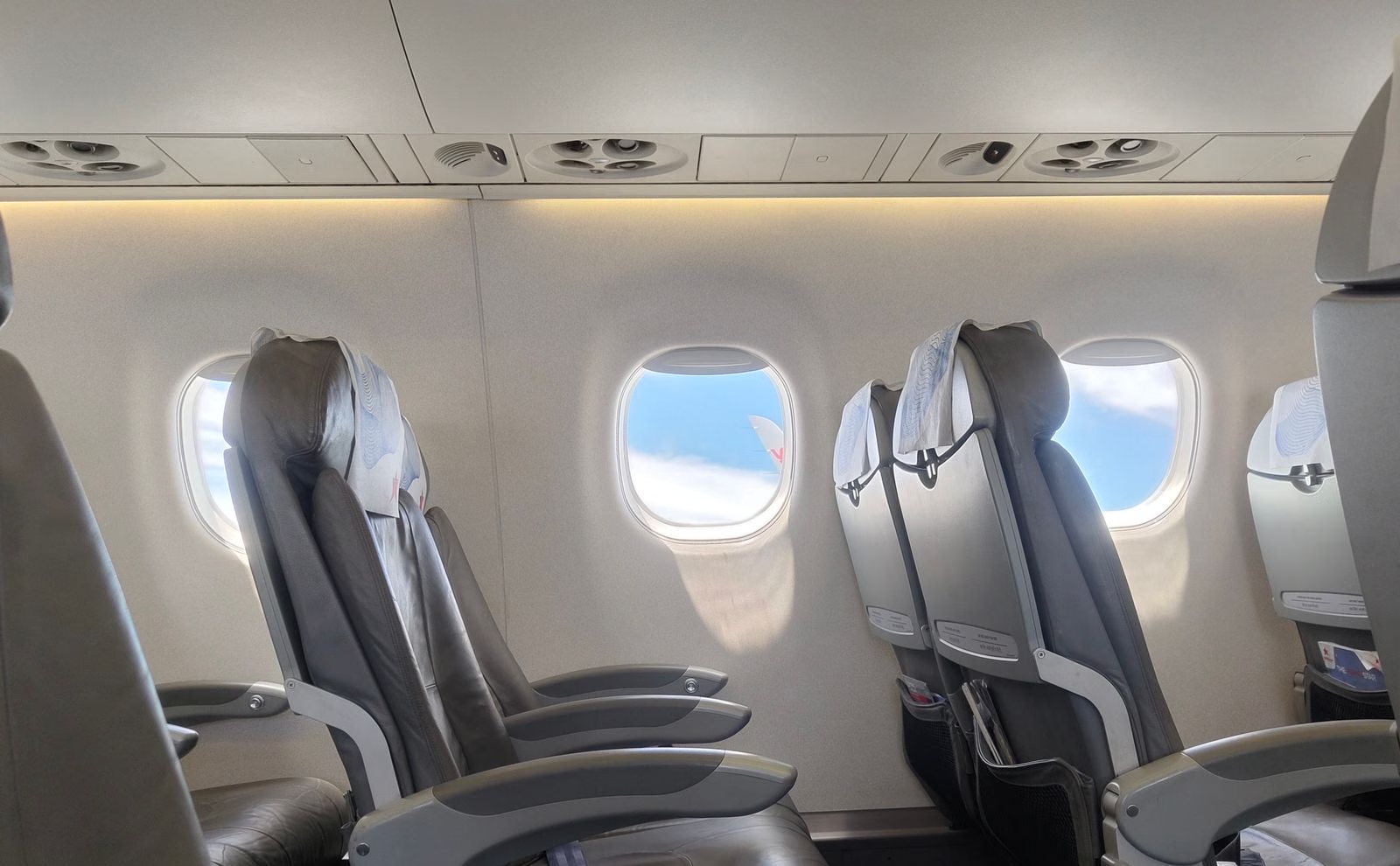
Modern aircraft blend roughly 50% fresh outside air with 50% recirculated air run through HEPA filtration, then push the mixture through the cabin at 20 to 30 air changes per hour. The full volume turns over about every two to four minutes. Air enters near the ceiling, sweeps down along the walls, and exits at floor level, circulating within a section rather than blowing lengthwise down the fuselage.
Now hold that against the claim that seats above the wing “experience the smallest changes in humidity during the flight.” For that to mean anything, someone would need to have parked a hygrometer at 22A and another at 8C and logged a measurable difference across a flight. Fresha published no such readings. No sensor, no sample size, no comparison figure, no paper. The release describes the work as having “analysed expert insights alongside cabin airflow patterns,” which is a sentence that sounds like a method and isn’t one.
The claim that center-block seats leave you with less post-flight tightness has the same problem, only louder, because now we’re talking about a measurable skin outcome attributed to a seat letter with nothing behind it.
Worth knowing who’s talking. Fresha sells bookings for salons, spas, and skin treatments. Health claims from a company that profits when you book a facial deserve the same skepticism as nutrition claims from a supplement brand. That doesn’t make the company dishonest, and its expert’s prep advice is perfectly reasonable. It does mean a seat chart with no published data behind it shouldn’t get repeated as a finding.
I’ll give the release this much. The cabin wall really is colder than the rest of the interior, since it’s the surface closest to outside air running around 60 degrees below zero Fahrenheit. Window passengers really do move less, because getting up means climbing over two strangers. Those are honest observations about comfort. Neither one produces a per-seat hydration ranking.
The Window Seat and UV: Where Experts Actually Disagree
This is the piece I expected to debunk quickly, and instead I found a real split between credible authorities. Both positions are worth having.
The case for sunscreen at 35,000 feet
The study everyone cites is Sanlorenzo and colleagues in JAMA Dermatology, 2015. They measured a carcinogenic effective irradiance of 0.87 mW/m² in a cockpit at cruising altitude against 2.45 mW/m² inside a tanning bed, which works out to roughly 57 minutes of flight time equaling a 20-minute tanning session. The same team’s meta-analysis found pilots and cabin crew carry about twice the melanoma incidence of the general population.
The case against worrying
Read that paper closely and you hit the caveat the press release skipped. Those measurements came from cockpit windshields, and the subjects were pilots. Reported UV-A transmission across aircraft glazing ranged from 0.41% all the way up to 53.5%, an enormous spread, and the paper notes that plastic attenuated more UV radiation than glass did.
Passenger windows are plastic. Three layers of it. Which is exactly why Cancer Council Australia states plainly that “there is no credible evidence to suggest passengers can get sunburnt on commercial airline flights, so Cancer Council does not recommend the need for sun protection,” adding that cabin window materials “are highly effective at blocking both UVA and UVB.”
Plenty of American dermatologists disagree and still tell window-seat passengers to apply broad-spectrum SPF 30 on daytime flights. Both camps are reading the same literature and weighing the uncertainty differently.
How I land on it: if you fly a few daylight legs a year, close the shade and stop thinking about it. If you’re in a window seat weekly with the shade up and sun on your arm for hours, sunscreen costs about eleven cents an application and removes the question entirely. Neither choice is wrong. Anyone selling you certainty here is overselling.
Claim by Claim: What Survives Scrutiny
| The claim | Verdict | What the evidence shows |
|---|---|---|
| Cabin humidity falls below 20%, drier than the Sahara | Holds up | Measured below 10% within two hours of takeoff in a peer-reviewed study. If anything the release undersold it. |
| Flying dehydrates facial skin | Holds up | Cheek skin capacitance fell by up to 37% during a long-haul flight. |
| Window seats mean more UV exposure | Contested | True for pilots behind cockpit windshields. Cancer Council Australia says passenger windows block both UVA and UVB. |
| First and last five rows are most dehydrating | Unsupported | No published measurements. Cabin air fully exchanges every two to four minutes. |
| Seats above the wing have the most stable humidity | Unsupported | No sensor data, sample size, or methodology released. |
| Center-block seats cause less post-flight tightness | Unsupported | A skin outcome assigned to a seat letter, with nothing behind it. |
| Skip retinol and acids for 24 hours before flying | Reasonable | Standard dermatology guidance. A compromised barrier plus sub-10% humidity is a bad pairing. |
| Apply barrier cream before boarding | Reasonable | Occlusive products slow water loss, and starting ahead beats catching up mid-flight. |
What Actually Helps, According to the Expert Who Got It Right
Danielle Louise, the beauty expert quoted in the Fresha release, gave advice I have no argument with. “Most people spend time choosing the right moisturiser before a flight, but very few think about where they’re sitting,” she said. I’d flip that. Think hard about the moisturizer. Stop thinking about the seat.
Her recommendations, plus what I’ve worked out over a lot of flights with kids:
Put the actives away 24 hours ahead
Retinol, glycolic acid, salicylic acid, all of it. These work by thinning or disrupting the outer layer of skin, which is precisely the layer standing between you and air at 8% humidity. Louise warns that a barrier already under stress “can become even more vulnerable during a long flight.” Resume the night you land.
Apply the heavy cream before you get on the plane
Occlusives are the point here, something with petrolatum or a thick ceramide base rather than a light gel. Put it on at the gate. The barrier needs to be sealed before the air starts pulling, not an hour into the flight when your face has already gone tight.
The 0.35 oz Aquaphor tubes, about $6.99 for two, are what live in my bag, mostly because they clear the TSA liquids rule without any thought and one tube outlasts a summer of flying. If petrolatum feels too heavy on your face, the fragrance-free Cetaphil cream in 3 oz jars, roughly $10.97 for three, does the same sealing work in a texture that sinks in. Either one beats whatever sample sachet you find in the seat pocket.
Carry a mist, not wipes
Cleansing wipes strip lipids you can’t spare up there. A hydrating mist over your existing cream buys you comfort without stripping anything. Refresh it every couple of hours.
Watch the can size, because most thermal water sprays come in 10 oz bottles that security will take off you. The 1.6 oz Avène Thermal Spring Water, around $11, is the version that actually fits carry-on rules.
Start drinking before the cart appears
Water at the terminal, water at the gate, water before the seatbelt sign. Beat the trolley, which on a full flight can take 45 minutes to reach you. Coffee and wine both work against you, though I’m not going to be the one telling a parent flying with a toddler to skip the wine.
Close the shade
Free, immediate, and it ends the UV debate outright. If you want the view, wear the sunscreen. If you want to nap, the shade handles it.
For the daytime window seats where you’d rather look out, a broad-spectrum facial fluid in a carry-on size covers it. La Roche-Posay Anthelios Ultra Light SPF 60 in the 1.7 oz bottle runs about $26.99. Given that Cancer Council Australia doesn’t think passengers need it at all, treat this as the belt-and-suspenders option rather than a requirement.
What I Do Now
Aquaphor at the gate, a thick layer, and I stopped caring how it looks. Lip repair ointment, two tubes for about $6.97, in my pocket rather than buried in the bag under the seat in front of me, because that bag is unreachable the second the person ahead of me reclines. A bottle of water bought past security every single time, even at four dollars, because I’ve stopped pretending I’ll flag down a flight attendant with a sleeping kid on my lap.
And I book the aisle. Not for my skin. For the fourteen trips to the bathroom that a family of four generates between takeoff and landing, which no press release has ever accounted for.
If you’re planning something longer this year, the same prep applies whether you’re chasing a quiet week somewhere cold or spending your days on the water like we did on a barge through Bordeaux. The flight is the flight. Handle it before you board.
The Bottom Line
Your seat assignment isn’t dehydrating your skin. The air is, all of it, everywhere in the cabin, from row 3 to the back galley. Cabin humidity sinks below 10% within two hours of takeoff and stays there, and facial hydration drops measurably as a result.
Skip the actives the day before. Seal your barrier at the gate with something thick. Drink early. Close the shade or wear SPF, your call. Then take whatever seat gets you closest to the aisle, the bathroom, or the kid most likely to need you.
Frequently Asked Questions
Does flying actually dry out your skin?
Yes, and it’s been measured. Cabin relative humidity falls below 10% within two hours of takeoff and remains there for the duration of the flight. A 2012 study in Skin Research and Technology tracked skin capacitance on the cheeks dropping by up to 37% during a long-distance flight.
Is the window seat worse for your skin than the aisle?
There’s no published evidence that it is. Aircraft exchange the entire cabin air volume every two to four minutes at 20 to 30 air changes per hour, which makes seat-level humidity differences implausible. The cabin wall is colder and window passengers move less, but neither produces a measurable hydration gap.
Do you need sunscreen on a plane?
Experts disagree. Cancer Council Australia says there is no credible evidence passengers can get sunburnt on commercial flights and does not recommend sun protection, because passenger windows are three layers of plastic that block both UVA and UVB. Many US dermatologists still advise broad-spectrum SPF 30 for daytime window seats. Closing the shade resolves it either way.
How dry is the air on a plane compared to a desert?
Drier. The Sahara averages around 25% relative humidity. Measured cabin humidity sits below 10% for most of a long flight, because the outside air being compressed into the cabin at cruising altitude holds almost no moisture.
Should I stop using retinol before a flight?
Pause it for 24 hours beforehand, along with AHAs and BHAs. These ingredients work by disrupting the outermost layer of skin, which is the same layer protecting you from extremely dry cabin air. Start again the night you land.
What’s the best moisturizer to wear on a plane?
Something occlusive rather than light, meaning petrolatum-based or a thick ceramide cream instead of a gel or serum. Apply it before boarding rather than mid-flight. The goal is sealing water in before the dry air starts pulling it out.
Why do my lips and eyes suffer more than the rest of my face?
Lips have no oil glands and a much thinner barrier, so they lose water first and fastest. Contact lenses dry against low-humidity air the same way, which is why they feel welded on by hour four. Both respond to the same fix: balm and drops applied early and reapplied often.
Does drinking water actually help your skin on a flight?
It helps your overall hydration, which matters, but it won’t stop moisture loss at the skin surface. That’s a barrier problem, not a fluid-intake problem. Drink water and apply an occlusive cream. The two do different jobs.
Are airplane cabins recirculating dirty air?
No. Cabin air is roughly 50% fresh outside air and 50% recirculated air passed through HEPA filters that capture at least 99.97% of airborne particles. The dryness is a separate issue entirely, caused by how little moisture the outside air holds at altitude.
Do flight attendants and pilots have worse skin outcomes?
They have measurably higher melanoma rates, roughly twice the general population according to a 2015 meta-analysis of more than 266,000 crew members. Whether that stems from in-flight UV, cosmic radiation, disrupted circadian rhythm, or sun exposure during layovers remains unsettled. Occasional passengers are not in the same exposure category.
Does a face mist replace moisturizer on a plane?
No. Water evaporating off your face in sub-10% humidity can leave skin drier than before. A mist works when it sits on top of an occlusive cream that traps it. On bare skin it’s a temporary comfort at best.
Which seat should I actually book?
Whichever one suits your trip. Aisle for bathroom access and legroom, window for sleeping against something solid and controlling the shade. Skin hydration shouldn’t factor in, because every seat in the cabin shares the same air.
Sources
- Guéhenneux S, Gardinier S, Morizot F, Le Fur I, Tschachler E. Skin surface hydration decreases rapidly during long distance flights. Skin Research and Technology, 2012.
- Sanlorenzo M, Vujic I, Posch C, Cleaver JE, Quaglino P, Ortiz-Urda S. The Risk of Melanoma in Pilots and Cabin Crew: UV Measurements in Flying Airplanes. JAMA Dermatology, 2015;151(4):450-452.
- Cancer Council Australia. Can you get sunburnt on a plane?
- International Air Transport Association. Cabin Air Quality briefing paper (air exchange rates and HEPA filtration).
- Federal Aviation Administration. Cabin Air Quality.
- Expert comment from Danielle Louise, beauty expert on the Fresha app, provided via press release, July 2026.